News
Filtered By
Results
MIT software tool turns everyday objects into animated, eye-catching displays
The FabObscura system helps users design and print barrier-grid animations without electronics, and can help produce dynamic household, workplace, and artistic objects.

Alzheimer’s erodes brain cells’ control of gene expression, undermining function, cognition
Study of 3.5 million cells from more than 100 human brains finds Alzheimer’s progression — and resilience to disease — depends on preserving epigenomic stability.
A greener way to 3D print stronger stuff
MIT CSAIL researchers developed SustainaPrint, a system that reinforces only the weakest zones of eco-friendly 3D prints, achieving strong results with less plastic.

3 Questions: The pros and cons of synthetic data in AI
Artificially created data offer benefits from cost savings to privacy preservation, but their limitations require careful planning and evaluation, Kalyan Veeramachaneni says.
Soft materials hold onto “memories” of their past, for longer than previously thought
New findings could help manufacturers design gels, lotions, or even paving materials that last longer and perform more predictably.
A new generative AI approach to predicting chemical reactions
System developed at MIT could provide realistic predictions for a wide variety of reactions, while maintaining real-world physical constraints.
MIT researchers develop AI tool to improve flu vaccine strain selection
VaxSeer uses machine learning to predict virus evolution and antigenicity, aiming to make vaccine selection more accurate and less reliant on guesswork.
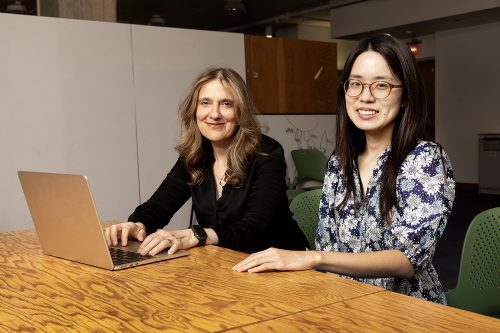
New method could monitor corrosion and cracking in a nuclear reactor
By directly imaging material failure in 3D, this real-time technique could help scientists improve reactor safety and longevity.

Simpler models can outperform deep learning at climate prediction
New research shows the natural variability in climate data can cause AI models to struggle at predicting local temperature and rainfall.

Can large language models figure out the real world?
New test could help determine if AI systems that make accurate predictions in one area can understand it well enough to apply that ability to a different area.