News
Filtered By
Results
AI-driven technique could help engineers design analog chips faster and with less expense
The “SLIC” training method enables a small LLM to compete with much more resource-intensive models in complex circuit design tasks.

Q&A: Enabling more human-like interactions and understanding in multimodal foundation models
Senior Research Scientist Jim Glass discusses how his MIT-IBM Computing Research Lab collaboration connects perception and language, and addresses the shortcoming of current models.

New approach enables physically consistent AI models of chaotic systems
Enforcing physics-based constraints prevents AI models from generating unreliable predictions for complex nonlinear systems in weather, climate, and turbulent flows.

Study reveals data centers’ long-distance damage to air quality
Researchers find air pollution from data center electricity use can affect communities far from the facilities, with some of the highest impacts in the Midwest.

Helping AI text detectors keep up with changing conditions
A more flexible training method can make AI text detectors more robust when new models emerge or AI-generated text is disguised to appear human.

This featherweight, flying robot carries its own sensors and computers
The speedy microrobot flies without an attached motion-capture system, moving it closer to applications like agriculture or industrial surveillance.

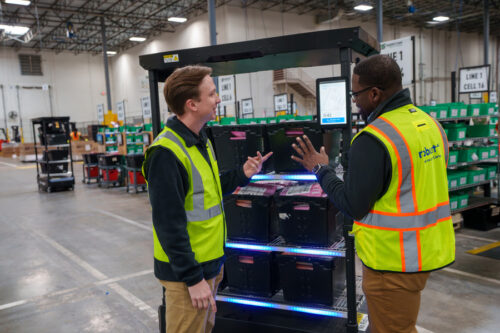
Helping robots fit into the human workplace
Founded by Anthony Jules ’92, SM ’92 and Professor Emeritus Rodney Brooks, Robust AI’s robots are designed to collaborate with humans in factories and warehouses.
New research could lead to faster, trustworthy AI models for climate prediction
MIT scientists developed a training method to generate models that simulate the effects of human activities on climate much more quickly than other approaches.

A single AI model simulates the behavior of many substances, from sliding sand to folding proteins
By learning how matter moves, the WorldParticle system could assist with developing soft robots, medicines, and more.

AI-assisted learning platform helps robots reason beyond literal commands
The new approach, known as FLEX, could lead to more intuitive, interactive household and assistive robots.