News
Filtered By
Results
This is your brain. This is your brain on code
MIT researchers are discovering which parts of the brain are engaged when a person evaluates a computer program.
Subtle biases in AI can influence emergency decisions
But the harm from a discriminatory AI system can be minimized if the advice it delivers is properly framed, an MIT team has shown.

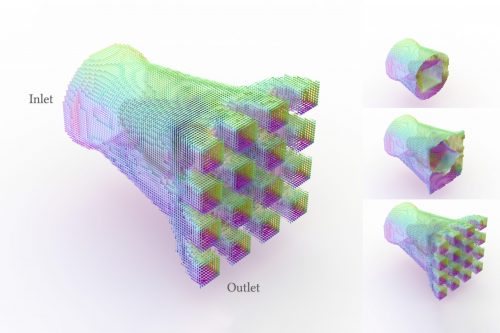
Computational system streamlines the design of fluidic devices
This computational tool can generate an optimal design for a complex fluidic device such as a combustion engine or a hydraulic pump.
A faster way to preserve privacy online
New research enables users to search for information without revealing their queries, based on a method that is 30 times faster than comparable prior techniques.

An automated way to assemble thousands of objects
A new algorithm for automatic assembly of products is accurate, efficient, and generalizable to a wide range of complex real-world assemblies.

Large language models help decipher clinical notes
Researchers used a powerful deep-learning model to extract important data from electronic health records that could assist with personalized medicine.

Busy GPUs: Sampling and pipelining method speeds up deep learning on large graphs
New technique significantly reduces training and inference time on extensive datasets to keep pace with fast-moving data in finance, social networks, and fraud detection in cryptocurrency.

Breaking the scaling limits of analog computing
New technique could diminish errors that hamper the performance of super-fast analog optical neural networks.

New device can control light at unprecedented speeds
Researchers have developed a programmable optical device for high-speed beam steering.

A simpler path to better computer vision
New research reveals a scalable technique that uses synthetic data to improve the accuracy of AI models that recognize images.