News
Results
Boosting faith in the authenticity of open source software
Speranza system brings hope to users that the package they download is functional software, not malware.

Automated system teaches users when to collaborate with an AI assistant
MIT researchers develop a customized onboarding process that helps a human learn when a model’s advice is trustworthy.
AI accelerates problem-solving in complex scenarios
A new, data-driven approach could lead to better solutions for tricky optimization problems like global package routing or power grid operation.

A new optimization framework for robot motion planning
MIT CSAIL researchers established new connections between combinatorial and continuous optimization, which can find global solutions for complex motion-planning puzzles.
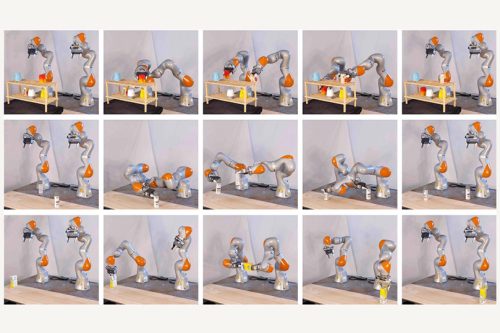
New method uses crowdsourced feedback to help train robots
Human Guided Exploration (HuGE) enables AI agents to learn quickly with some help from humans, even if the humans make mistakes.

Synthetic imagery sets new bar in AI training efficiency
MIT CSAIL researchers innovate with synthetic imagery to train AI, paving the way for more efficient and bias-reduced machine learning.

Technique enables AI on edge devices to keep learning over time
With the PockEngine training method, machine-learning models can efficiently and continuously learn from user data on edge devices like smartphones.

This 3D printer can watch itself fabricate objects
Computer vision enables contact-free 3D printing, letting engineers print with high-performance materials they couldn’t use before.

Explained: Generative AI
How do powerful generative AI systems like ChatGPT work, and what makes them different from other types of artificial intelligence?

Using AI to optimize for rapid neural imaging
MIT CSAIL researchers combine AI and electron microscopy to expedite detailed brain network mapping, aiming to enhance connectomics research and clinical pathology.