News
Results
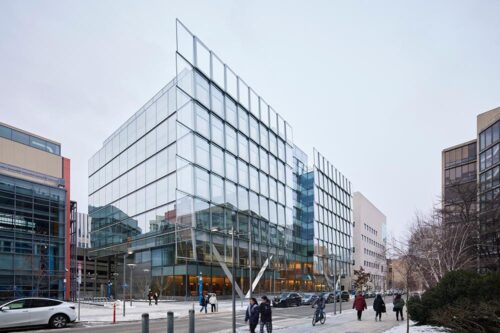
A crossroads for computing at MIT
The MIT Schwarzman College of Computing building will form a new cluster of connectivity across a spectrum of disciplines in computing and artificial intelligence.
Growing our donated organ supply
Graduate student Hammaad Adam is working to increase the supply of organs available for transplants, saving lives and improving health equity.

New AI method captures uncertainty in medical images
By providing plausible label maps for one medical image, the Tyche machine-learning model could help clinicians and researchers capture crucial information.

A faster, better way to prevent an AI chatbot from giving toxic responses
Researchers create a curious machine-learning model that finds a wider variety of prompts for training a chatbot to avoid hateful or harmful output.

3 Questions: New faculty interview with Abigail Bodner
An assistant professor in EAPS and EECS, Bodner discusses the relationship between small processes and large-scale climate effects, and more.

When an antibiotic fails: MIT scientists are using AI to target “sleeper” bacteria
Most antibiotics target metabolically active bacteria, but with artificial intelligence, researchers can efficiently screen compounds that are lethal to dormant microbes.

A new computational technique could make it easier to engineer useful proteins
MIT researchers plan to search for proteins that could be used to measure electrical activity in the brain.

New software enables blind and low-vision users to create interactive, accessible charts
Screen-reader users can upload a dataset and create customized data representations that combine visualization, textual description, and sonification.

Large language models use a surprisingly simple mechanism to retrieve some stored knowledge
Researchers demonstrate a technique that can be used to probe a model to see what it knows about new subjects.

AI generates high-quality images 30 times faster in a single step
Novel method makes tools like Stable Diffusion and DALL-E-3 faster by simplifying the image-generating process to a single step while maintaining or enhancing image quality.
